
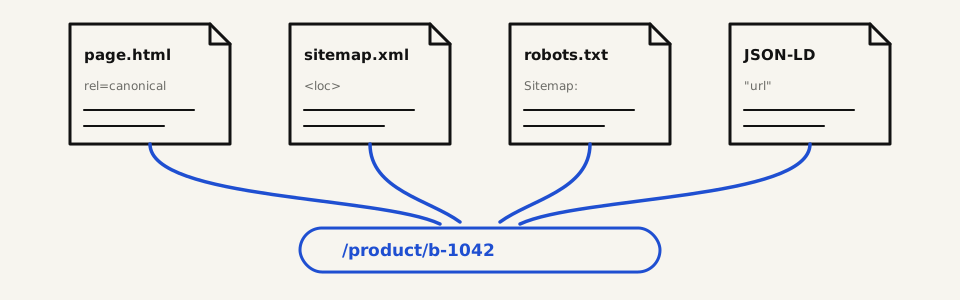
The first SEO issue on a commerce platform rarely starts in Search Console. It usually starts when one URL says a page exists, the sitemap says it matters, the markup says something else, and the catalog data cannot arbitrate between them.
Problem
Technical SEO is still treated too often as a plugin problem. In practice, it is an information-architecture problem with search consequences.
On an ecommerce platform, several layers are supposed to tell the same story:
- the route that exposes a page;
- the canonical URL that claims which version matters;
- the sitemap that declares what deserves discovery;
- the structured data that turns page content into machine-readable entities;
- the product data that feeds price, availability, images, and taxonomy.
When those layers diverge, the failure is not abstract. Search engines get mixed signals. Teams start guessing whether the problem is markup, routing, or catalog quality. And SEO work becomes reactive because nobody knows which surface is authoritative.
Decision
The decision is to treat technical SEO as a format problem first.
That means keeping routing, canonical output, robots handling, and sitemap generation close to the same normalized read layer. In this repo, even the robots.txt output stays explicit instead of being hidden behind hosting defaults:
$content = implode(PHP_EOL, [
    'User-agent: *',
    'Allow: /',
    'Sitemap: '.url('/sitemap.xml'),
]);
The same logic applies to the sitemap. A route should appear there because it is canonical and public, not because a file happened to exist or a page got linked once.
The alternative would be the usual drift: one tool manages redirects, another emits markup, another owns feed generation, and nobody can say which layer wins. That setup works until catalog changes, locale routes, and editorial pages start interacting. Then every SEO fix turns into detective work.
Result
Once these surfaces share the same contract, technical SEO becomes calmer.
You can reason about the site with fewer hidden rules. A page is public because the application decided it is public. It is canonical because the same runtime says so. It appears in the sitemap because the same data model exposes it. Structured data then becomes the last expression of a decision that was already coherent upstream.
This is especially important in ecommerce because structured data is not isolated from the catalog. A clean Product node is only useful if the URL is stable, the page is indexable, the image is usable, and the availability field reflects something the business side can stand behind.
That is why I keep linking this topic back to Schema.org, rich results, and product images. The markup layer only stays credible when the lower layers are aligned.