
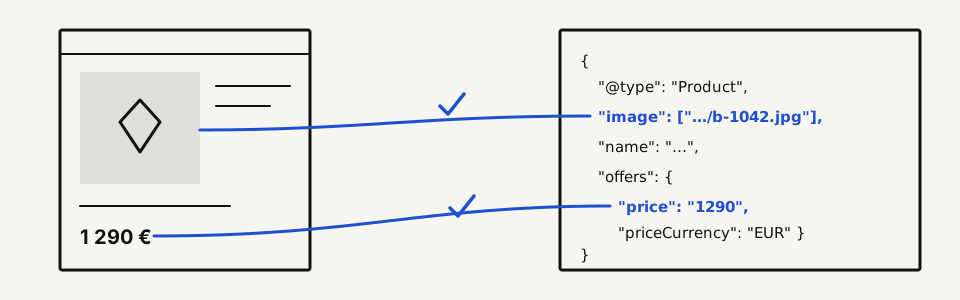
The quickest way to make structured data useless is to treat it like a decoration layer. In ecommerce, the markup only holds if the page, the catalog, and the assets are already telling the same story.
Problem
The Product schema type looks deceptively simple. It suggests that a valid payload is mostly a field-mapping exercise. In real catalogs, the harder part is elsewhere:
- some products are unique pieces rather than clean variant families;
- some collection pages want SEO value but should not pretend to be product detail pages;
- some image formats look fine in the app and still behave poorly in rich results;
- some catalog values exist in the back office but are not stable enough to expose as machine-readable facts.
That is why structured data fails so often in commerce: not because the schema is unavailable, but because the payload says more than the page and the catalog can safely prove.
Decision
The decision is to start from the public page and work backwards toward the markup, not the other way around.
A product page deserves Product markup when the URL, title, offer data, and primary image all describe the same sellable entity. That can look as simple as this:
{
  "@context": "https://schema.org",
  "@type": "Product",
  "name": "Rolex Oyster Perpetual Datejust 36",
  "image": [
    "https://example.com/images/datejust-36.jpg"
  ],
  "brand": {
    "@type": "Brand",
    "name": "Rolex"
  },
  "offers": {
    "@type": "Offer",
    "priceCurrency": "EUR",
    "price": "9450.00",
    "availability": "https://schema.org/InStock",
    "url": "https://example.com/watches/datejust-36"
  }
}
The important part is not the syntax. It is the restraint. If the image is not stable, if the stock data is late, or if the page is really a collection page, then the safer decision is to reduce the claim instead of over-marking the page.
That is also where image format decisions stop being cosmetic. WebP may be efficient for the frontend, but product rich results often behave more predictably with JPEG or PNG assets that stay easy for search engines to fetch and reuse. I would rather ship a slightly heavier but reliable asset than a theoretically cleaner format that fails in the one place the team actually cares about.
Result
Once the markup is treated as an extension of catalog truth, structured data becomes easier to maintain.
Teams stop asking "what else can we add?" and start asking "what can we stand behind?" That is a healthier question. It reduces noisy markup, makes product pages easier to reason about, and keeps the SEO layer tied to actual business data instead of wishful formatting.
This note connects directly to Technical SEO, sitemaps, and structured data for commerce, because the markup only matters when the route and the canonical layer are already coherent. It also belongs near the case study Product-data flows between ERP, PIM, and commerce, where the quality of offer and image data is decided before the frontend ever renders a page.