
Where it comes from
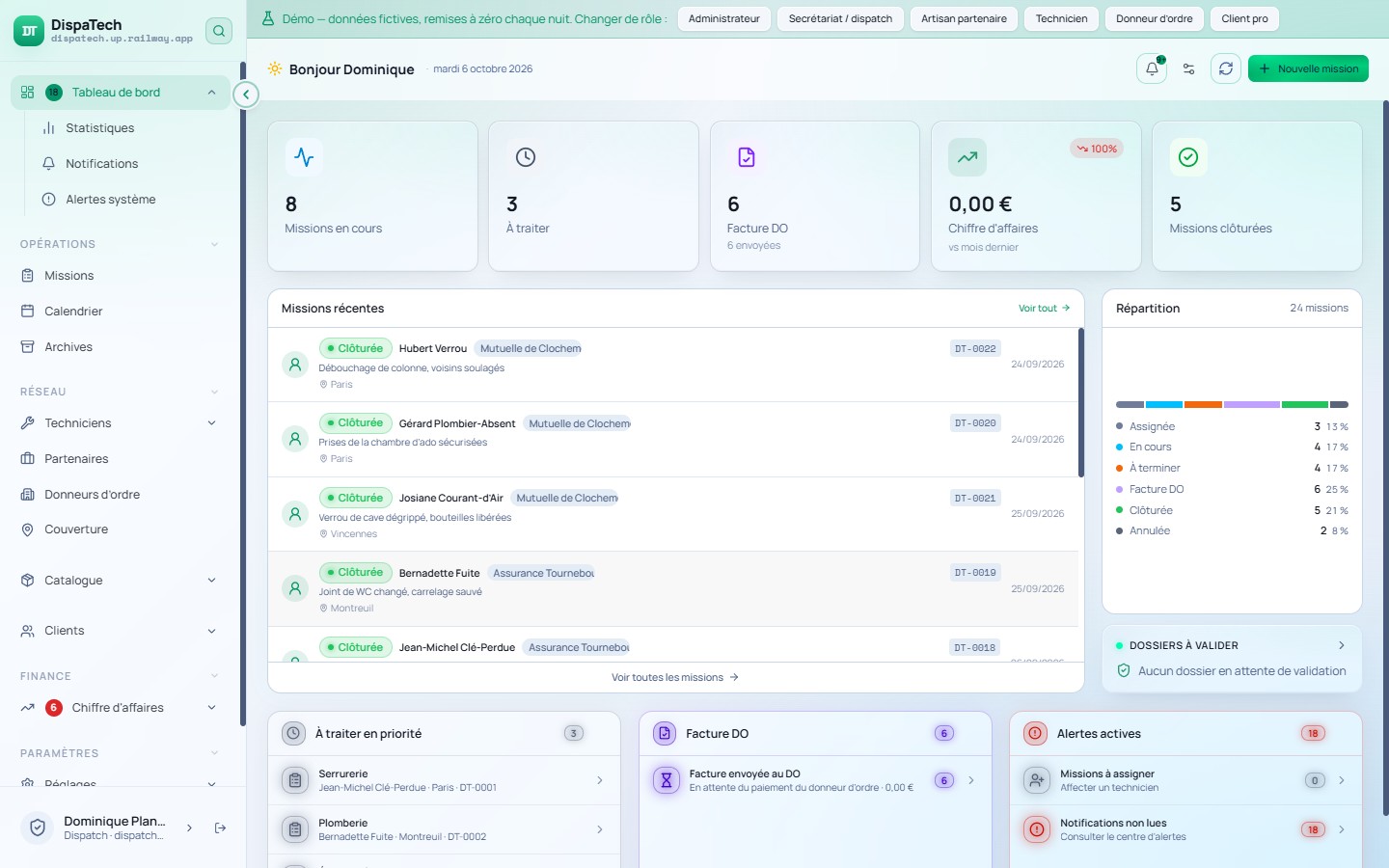
I designed and built, alone, a platform for a home-repair business: locksmithing, plumbing, glazing, heating, electrical work. Client companies order jobs, tradespeople carry them out, and the platform connects them, follows every job and produces the documents.
That project is archived. DispaTech is what came after it, without its brands or its clients, offered under licence to other networks. The change of business model that came before it, from subcontractors to partners, is told in a journal entry.
What the product does
- One job, five phases. To accept, in progress, to finish, to close, archived. The phase is computed from the state of the job; nobody types it in.
- The technician, on a phone. A fifteen-step flow: before and after photos, quote, waiver, certificate, report.
- The documents. Quote, certificate and report generated as PDFs and signed on screen.
- A space per role. The dispatch dashboard, the partner tradesperson's space, the client company's portal.
The white label
A new instance is configured with BRAND_* variables, on the server and on the web alike: the name, the colours, the addresses. Nothing is done by search-and-replace in the code. The packages were renamed along the way, so that none carries the old name any more.
A demo you try in one click
The demo opens a session per role, with no account to create: administrator, office and dispatch, partner tradesperson, technician, client company, business customer.
- The data is fictional and always the same, reset every night at 02:00 UTC.
- No email ever leaves. The demo accounts are locked: changing their password or deleting them is refused.
- The site and the API share one origin, through an
/apirelay. Without it, Safari logged the user out every fifteen minutes. - Trials are measured with no IP address and no third-party tracker: which roles were tried, and how far. The administrator reads them in a "Demo activity" view.
A tutorials site explains each role, the documents and the signatures. Its screenshots are regenerated by a script, and the licence grid is written in one place only.
The licence
Two plans.
- Autonomous dispatch: €690 excl. VAT per month, up to five technicians, and €1,500 excl. VAT for the setup, once. A company runs its own dispatch there, with its technicians and the client companies it prospects itself. The first month is 25% off (€517.50 excl. VAT), while the network gathers enough technicians.
- White label: €1,290 excl. VAT per month for the base (licence, hosting, maintenance), and €3,500 excl. VAT for the setup, once. One client-company integration is included each year, the next ones at €1,500 excl. VAT.
Either way, changes are €650 excl. VAT per day, and electronic invoicing (Factur-X) is on quote.
Negotiable on scope and commitment. The details are on the licence page.
Before closing
A final review by an independent reviewer found four serious defects, fixed before closing, among them a server crash on a corrupted cookie.
What is left to do
- A domain of its own: the demo still lives on
*.up.railway.appaddresses. - A test on a real iPhone, in Safari, and a check of the nightly reset.
- The free hosting puts the demo to sleep: the first call after a pause is slow, while it wakes up.